On Sunday, I watched the images of Ricardo Kaká standing once again before San Siro, receiving the recognition of AC Milan’s Hall of Fame.
I expected to feel proud. I did not expect the moment to affect me so deeply.
Perhaps it was the sight of Kaká becoming emotional. Perhaps it was hearing San Siro respond to him with the affection reserved for those who gave the supporters something that time cannot take away. Or perhaps it was because, for a few minutes, the years between that extraordinary Milan and the present seemed to disappear.
I was no longer simply watching a ceremony.
I was remembering.
I remembered the young Brazilian who arrived at Milan in 2003 with a quiet smile and an extraordinary ability to move with the ball. There was something different about Kaká from the beginning. His football was elegant but decisive. He seemed to accelerate without disturbing the rhythm of the match, moving through spaces that others had not yet recognised.
Yet what made him special was not only his talent.
There was a humility in the way he carried it.
Kaká became one of the finest players in the world without allowing greatness to become distance. He represented ambition without arrogance, excellence without unnecessary noise and faith without performance. In an era filled with powerful personalities and established champions, he found his place through ability, discipline and character.
His official Milan record tells us about seven seasons, 307 appearances and 104 goals. It recalls the Scudetto, Athens, the Champions League, the Club World Cup and the Ballon d’Or. Those numbers establish his place in the history of the club. But they cannot fully explain the emotional place he occupies in the lives of those who watched him. AC Milan’s Hall of Fame profile records the scale of his Rossoneri career.
For many of us, Kaká is connected permanently to 2007.
Athens was more than another European victory. It carried the memory of Istanbul, the determination to return and the satisfaction of seeing a difficult journey completed. Kaká was central to that journey. He played with courage and freedom, but also with an evident sense of responsibility towards the team around him.
Watching him enter the Hall of Fame brought all of that back.
But my memories of Kaká are not limited to matches watched from Malta or to the great European nights that remain part of Milan’s collective history.
I remembered the privilege of meeting him.
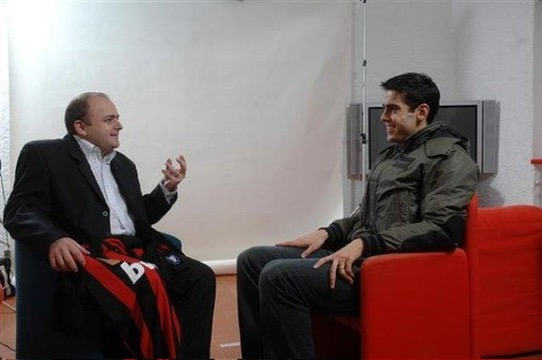
I remembered sitting opposite him, speaking with him and seeing at close range the calmness and courtesy that accompanied the footballer admired across the world. I remembered the signed shirt, the photographs and those small personal connections which, with the passing of time, have become more meaningful rather than less.
Objects preserve part of a memory. A shirt, a signature or a photograph can return us instantly to a particular room and a particular conversation. But what remains most strongly is the feeling a person left behind.
With Kaká, that feeling was one of grace.
That is why his recognition belongs to more than statistics or trophies. It celebrates someone who became part of Milan’s identity while remaining recognisably himself.
The supporters selected Kaká alongside Carlo Ancelotti and Ruud Gullit as one of the greatest midfielders in the club’s history. Together, they entered the Hall of Fame’s Class of 2026—not simply because they won, but because they embodied something that Milan supporters recognised as their own. The club described the honour as recognition of their ability to represent Milan’s passion, values and achievements.
It would be easy to treat a Hall of Fame as a place where the past is carefully stored.
I see it differently.
It is a bridge.
It allows one generation to say to another: this person mattered; this is what he gave us; this is why we still remember.
When Kaká stood before San Siro again, I felt the distance between Malta and Milano, between the boy watching Milan on television and the adult who would later enter parts of that world, become unexpectedly small.
The moment reminded me why Milan has never been only a football club in my life.
It has been a source of dreams, relationships and ways of understanding excellence. It has introduced me to people whose influence reached beyond the pitch. It has given me memories that belong simultaneously to millions of supporters and, in their own quiet way, only to me.
Kaká’s induction did not create his place in Milan’s history. That place was already secure.
What the ceremony did was allow memory to become visible.
San Siro remembered the goals, the movement and the magic. I remembered those things too. But I also remembered the person, the encounter, the shirt and the extraordinary journey that connected a supporter in Malta to one of the defining figures of Milan’s modern history.
For a few minutes, I was watching Kaká again.
And I realised that I was also watching a part of my own life return to the pitch.
Jesmond Saliba
2 November 2026